
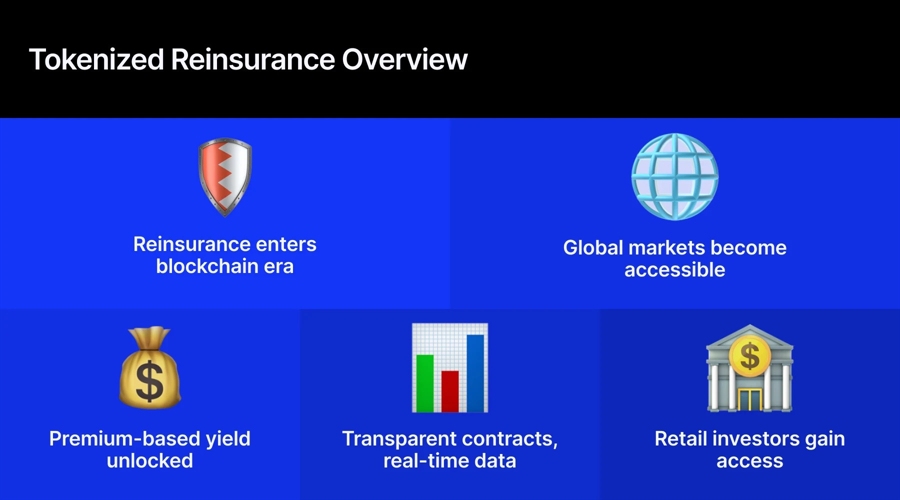
Tokenized capital meets traditional reinsurance
Crypto reinsurance in 2026 is no longer an experimental niche; it is a structured integration of on-chain liquidity and traditional risk transfer. The sector has moved beyond simple proof-of-concept deployments to handle substantial, real-world exposure. At the center of this shift is the Re Protocol, which functions as an on-chain marketplace bridging customary reinsurance markets with blockchain infrastructure.
The scale of this integration is evident in recent capacity authorizations. According to reporting from Insurance Business Mag, the decentralized reinsurance infrastructure platform Re has authorized US$134 million in reinsurance capacity across multiple programs ahead of the 2026 renewals. This figure underscores a significant step toward institutional-grade reliability, where tokenized assets back tangible risk pools.
The RE token serves as the governance mechanism for this ecosystem, enabling participants to influence protocol parameters and risk allocation. By tokenizing capital, the platform allows for more efficient capital deployment compared to traditional reinsurance cycles, which are often hampered by slow settlement and opaque tracking. This efficiency is critical for DeFi protocols that require rapid, verifiable coverage against smart contract failures or oracle manipulations.
The market activity surrounding the RE token reflects this growing utility. Traders and insurers alike are monitoring liquidity depth as a proxy for market confidence. The integration of tokenized capital does not replace traditional reinsurers but rather extends their reach, allowing capital to flow more freely into DeFi risk management. This hybrid model aims to stabilize the volatile DeFi landscape by providing a more resilient, transparent layer of financial protection.
AI actuarial models drive underwriting precision
The volatility of crypto assets creates a fundamental challenge for traditional underwriting. Standard deviation models often fail to capture the sudden, non-linear price drops characteristic of digital assets. Without precise risk assessment, DeFi protocols face capital inefficiency or insolvency during market stress.
AI-driven actuarial models address this by analyzing real-time on-chain data. These systems process transaction volumes, smart contract interactions, and historical volatility patterns to price risk more accurately. Unlike static models, AI adapts to the unique behavior of decentralized finance, reducing the margin of error in capital allocation.
This precision allows crypto reinsurance 2026 solutions to offer stable coverage without excessive premiums. By replacing guesswork with data, insurers can underwrite complex DeFi positions with confidence. The result is a more resilient capital stack that supports long-term protocol growth.
Swiss Re has noted that crypto assets present unexpected loss opportunities, highlighting the need for specialized risk frameworks [src-serp-8]. As the market matures, AI underwriting becomes essential for stabilizing the financial infrastructure of decentralized systems.
Stablecoins as a New Capital Source
Stablecoin holders are becoming a primary source of reinsurance capital for DeFi protocols. This shift transforms idle digital dollars into active risk-bearing assets, creating a new yield source while directly backing decentralized financial stability. By tapping into the vast liquidity of the stablecoin market, crypto reinsurance 2026 models unlock capital that was previously excluded from traditional insurance structures.
Projects like Re are leading this transition by converting traditional reinsurance premiums into onchain yield opportunities. This approach opens gated premiums to the broader stablecoin holder base, allowing individuals to earn returns by underwriting protocol risks. The mechanism aligns the incentives of capital providers with the health of the DeFi ecosystem they inhabit.
Major deployments signal market confidence
The shift from pilot programs to substantial capital allocation defines the current state of crypto reinsurance 2026. In January 2026, the blockchain-based platform Re authorized $134 million in reinsurance capacity across multiple underwriting programs. This capital deployment was not a speculative test but a structured renewal cycle, indicating that traditional insurance markets are actively integrating decentralized infrastructure for risk transfer.
This scale of commitment suggests that tokenized capital is no longer an experimental niche but a functional component of the broader reinsurance market. By leveraging on-chain liquidity, platforms like Re are providing the deep pockets required for large-scale DeFi protocols and traditional insurers seeking to hedge digital asset exposure.
| Feature | Traditional Reinsurance Capacity | Tokenized On-Chain Capacity (Re) |
|---|---|---|
| Capital Deployment | $134M (Jan 2026 Renewal) | $134M (Jan 2026 Renewal) |
| Settlement Speed | Months to years | Near-instant (on-chain) |
| Transparency | Private bilateral contracts | Publicly verifiable smart contracts |
| Liquidity Source | Institutional balance sheets | Tokenized global capital pools |
The comparison above highlights the efficiency gains inherent in tokenized structures. While traditional reinsurance relies on slow, opaque bilateral agreements, the Re deployment demonstrates that tokenized capital can match conventional capacity figures while offering superior transparency and speed. This duality is driving further adoption as insurers seek to reduce settlement risk and improve capital efficiency.
| Feature | Traditional Reinsurance | Tokenized On-Chain |
|---|---|---|
| Capital Scale | $134M (Jan 2026) | $134M (Jan 2026) |
| Settlement | Months | Instant |
| Transparency | Low | High |
Smart contract insurance trends for 2026
The architecture of crypto reinsurance 2026 is shifting from reactive payouts to proactive risk distribution. Traditional single-pool models are proving insufficient for protocols managing multi-million dollar treasuries, creating demand for layered coverage structures that mimic traditional Lloyd’s syndicates. This evolution prioritizes capital efficiency, ensuring that a single exploit does not drain a protocol’s entire liquidity reserve.
Tokenized capital markets are now the primary mechanism for this distribution. Instead of relying on a single insurer, protocols tap into decentralized capital pools where specific layers of risk are sold as tokenized policies. This allows capital providers to underwrite specific smart contract vulnerabilities, such as oracle manipulation or governance attacks, rather than providing blanket coverage. The result is a more granular pricing model where premiums reflect the actual code quality and historical audit results of the target protocol.
This structure protects protocol treasuries by capping exposure. When a catastrophic failure occurs, the loss is absorbed by the specific reinsurance layer designated for that event, preserving the core operational funds. As Swiss Re notes in its SONAR research, the underwriting of crypto assets requires understanding these unexpected loss vectors to create viable coverage. By integrating these tokenized reinsurance layers, protocols can stabilize their balance sheets against the high-stakes volatility inherent in decentralized finance.
No comments yet. Be the first to share your thoughts!