
Crypto reinsurance 2026 limits to account for
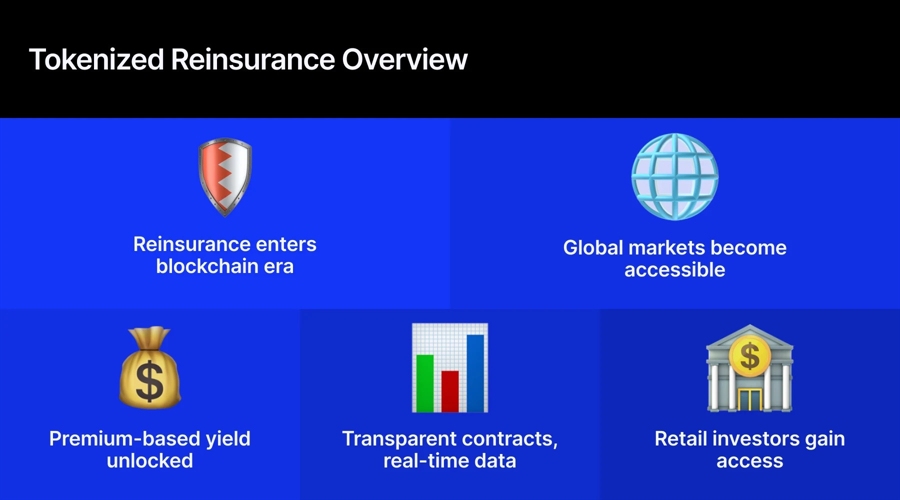
The reinsurance market is entering 2026 at record capacity, with approximately $540 billion in traditional dedicated capital and $120 billion in insurance-linked securities (ILS) bolstered by three consecutive years of robust earnings. This massive influx of liquidity is colliding with a crypto industry projected to reach $3.35 billion in market size, creating a unique convergence for decentralized risk transfer.
At the center of this shift is Re Protocol, an on-chain marketplace integrating customary reinsurance markets with blockchain technology. The platform recently authorized $134 million in reinsurance capacity across multiple programs ahead of the 2026 renewals, signaling a tangible move from speculative interest to operational infrastructure. The rapid rise of its governance token, RE, driven by immediate listings on major exchanges like Binance and Coinbase, has brought significant liquidity to the sector, allowing for broader access to these new capital pools.
While traditional insurers remain cautious about crypto’s volatility, the efficiency gains of on-chain modeling are reshaping capital deployment. By aligning the massive, stable capital of traditional reinsurance with the agile, data-rich environment of DeFi, the 2026 landscape offers a pragmatic path for managing digital asset risk without relying on the opaque legacy systems of the past.
Crypto reinsurance 2026 choices that change the plan
As decentralized reinsurance platforms like Re Protocol authorize $134 million in capacity for 2026 renewals, the market is shifting from speculative experimentation to structured capital deployment. Evaluating these systems requires looking beyond token price action to the underlying mechanics of risk transfer. The tradeoffs center on how AI-driven modeling balances speed against the regulatory scrutiny that traditional reinsurers face.
| Factor | On-Chain Reinsurance | Traditional Reinsurance |
|---|---|---|
| Capital Efficiency | High; smart contracts automate payouts and reduce administrative overhead. | Lower; heavy reliance on manual underwriting and intermediaries. |
| Speed of Settlement | Near-instant upon trigger event verification. | Weeks to months for claims processing and capital release. |
| Regulatory Compliance | Evolving; limited jurisdictional clarity in many regions. | Established; strict capital adequacy and reporting requirements. |
| Transparency | Full visibility into reserve levels and claim history via blockchain. | Partial; sensitive data often protected by non-disclosure agreements. |
Liquidity and Token Volatility
The RE token’s rapid rise was fueled by listings on major exchanges like Binance and Coinbase, providing immediate liquidity. However, this creates a volatility risk for policyholders. If the token backing a reinsurance pool crashes, the effective coverage value drops unless stablecoin collateral is strictly enforced. Traders must weigh the convenience of instant access against the risk of holding a governance token that may not track the underlying risk accurately.
AI Modeling Accuracy
AI-driven risk models promise to identify patterns invisible to human underwriters, but they also introduce "black box" risks. In 2026, the tradeoff is between model speed and explainability. Traditional reinsurers prefer transparent actuarial tables, while DeFi platforms rely on code-based logic. If an AI model misprices a catastrophic event, the smart contract executes automatically, leaving no room for the nuanced negotiations typical of traditional reinsurance markets.
Regulatory Arbitrage
Many crypto reinsurance platforms operate in jurisdictions with lighter oversight to attract capital. This offers lower premiums but higher counterparty risk. Traditional reinsurers benefit from decades of legal precedent and capital buffers. For 2026, the key decision is whether the cost savings of crypto reinsurance justify the potential loss of legal recourse in case of platform failure or regulatory crackdowns.
How to choose the right AI-driven reinsurance partner
The 2026 crypto reinsurance market is no longer theoretical. With Re Protocol authorizing $134 million in capacity for upcoming renewals and traditional dedicated reinsurance capital projected to hit $540 billion, the infrastructure is active and scaling. However, not all platforms offer the same risk modeling capabilities or capital efficiency. Choosing the right partner requires looking beyond tokenomics to the underlying data architecture.
Use this five-step framework to evaluate whether a specific AI-driven reinsurance model fits your DeFi protocol’s risk profile.
AI modeling is only as good as its inputs. Traditional reinsurance relies on historical loss ratios, but crypto protocols generate unique, real-time on-chain data. Look for platforms that integrate direct oracle feeds rather than relying on aggregated, delayed market data. Granular data allows for dynamic pricing adjustments based on current volatility rather than backward-looking averages.

The primary advantage of AI-driven reinsurance is capital efficiency. Evaluate how the platform utilizes parametric triggers versus traditional indemnification models. Parametric covers release funds automatically when specific on-chain conditions are met, reducing administrative overhead and ensuring faster liquidity for your protocol during a crisis.

As seen with the RE token’s rapid ascent, broad liquidity is critical for governance and stability. Ensure the reinsurance provider has listings on major exchanges like Binance or Coinbase. Deep liquidity pools mean your protocol can exit or adjust positions without significant slippage, protecting your treasury from market manipulation during high-volatility events.

In decentralized reinsurance, governance determines risk appetite. Choose platforms where voting power is distributed among verified risk managers and institutional capital providers, not just large token holders. Transparent on-chain voting records allow you to audit how capital allocation decisions are made and whether risk parameters align with your protocol’s security standards.
DeFi protocols are highly correlated. A failure in one major lending platform often cascades into others. Ensure the reinsurance provider uses AI models that account for systemic, correlated risks rather than treating each protocol as an isolated event. If their model cannot simulate a "black swan" cascade scenario, it is not robust enough for 2026’s interconnected DeFi landscape.
By following these steps, you can move from speculative adoption to strategic integration. The goal is not just to buy insurance, but to select a partner that enhances your protocol’s resilience through superior data and capital efficiency.
Spotting the Weak Links in 2026 DeFi Reinsurance
As the crypto reinsurance market expands, distinguishing between genuine innovation and marketing fluff becomes critical. The sector is seeing record capacity—approximately $540 billion in traditional dedicated reinsurance capital and $120 billion in ILS capital—but the on-chain layer faces specific scrutiny regarding capital efficiency and risk modeling accuracy.
Overstated AI Risk Models
Many protocols claim their AI-driven models eliminate underwriting risk. In reality, these models often rely on historical on-chain data that may not predict black-swan events like smart contract exploits or oracle failures. Verify that the model includes stress-testing against non-correlated market shocks, not just past price action.
Illiquid Governance Tokens
Some platforms tie reinsurance capacity to volatile governance tokens. If the token price drops, the protocol’s solvency ratio can plummet instantly. Look for reserves backed by stablecoins or blue-chip assets rather than native tokens. A token listing on major exchanges like Binance or Coinbase boosts liquidity but does not guarantee the underlying risk model is sound.
Hidden Smart Contract Risks
The "smart contract is law" narrative ignores the reality of bugs. Even if the risk model is perfect, a vulnerability in the code can drain the pool. Check for audit history from reputable firms and whether the protocol has bug bounty programs. Without these, the capital efficiency gains are illusory.
Fragmented Liquidity Pools
New entrants often split liquidity across multiple chains to appear global. This fragmentation can lead to slippage during claims settlement. Prioritize protocols with deep, consolidated liquidity on major networks like Ethereum or Solana, where claims can be settled instantly without significant price impact.
No comments yet. Be the first to share your thoughts!