
DeFi needs a reinsurance backstop
Decentralized finance protocols operate on thin margins of trust, relying on smart contract code rather than legal recourse. When tail risks materialize—through oracle failures, liquidity crunches, or exploit events—the financial damage is immediate and total. Traditional insurance models, with their slow underwriting cycles and opaque claims processes, cannot keep pace with the velocity of on-chain capital. DeFi requires a safety layer that is as fluid and transparent as the protocols it protects.
Reinsurance serves as the institutional-grade backstop for this ecosystem. By pooling risk across multiple capital sources, it stabilizes the underlying assets against catastrophic losses. This is not merely about protection; it is about enabling scale. Protocols can offer higher yields and deeper liquidity when they know a robust reinsurance layer exists to absorb shocks. Without it, DeFi remains a high-risk experiment rather than a stable financial infrastructure.
The mechanism is straightforward: protocols pay premiums into a reinsurance pool, which is managed by AI-driven models that assess risk in real-time. These models analyze on-chain data, historical performance, and market conditions to price risk accurately. When a loss event occurs, the reinsurance pool covers the deficit, preventing protocol collapse and maintaining user confidence. This creates a feedback loop where stability attracts more capital, which in turn strengthens the reinsurance pool.
Recent developments highlight the urgency of this infrastructure. Blockchain reinsurance platform Re has already authorized $134 million in capacity for 2026 renewals, signaling growing institutional interest in decentralized risk management. As DeFi protocols continue to attract billions in total value locked (TVL), the need for reliable, automated reinsurance becomes critical. The difference between a resilient protocol and a failed one often comes down to whether it has a backstop that can act instantly.
The chart above illustrates the volatility inherent in crypto assets. While Ethereum’s price action is the most visible metric, the underlying risk to DeFi protocols is even more complex. Smart contract risk, liquidity risk, and composability risk create a web of vulnerabilities that traditional insurance cannot untangle. AI-driven reinsurance models are designed to navigate this complexity, offering a dynamic safety net that adapts to changing market conditions.
As the industry matures, reinsurance will transition from a niche feature to a standard requirement. Protocols that fail to integrate robust reinsurance mechanisms will struggle to attract institutional capital. The future of DeFi depends on its ability to mimic the stability of traditional finance while retaining the efficiency of decentralization. Reinsurance is the bridge between these two worlds.
AI models replace manual actuarial tables
Traditional reinsurance relies on static actuarial tables—historical datasets that update annually or quarterly. In DeFi, this lag is fatal. Market conditions shift in seconds, not fiscal quarters. Static models cannot capture the velocity of flash loans, liquidation cascades, or sudden liquidity evaporation. They treat risk as a fixed variable, leaving insurers exposed to tail events that occurred before the last data refresh.
AI-driven risk modeling processes on-chain data in real-time. Instead of waiting for end-of-day reports, these models ingest live transaction streams, liquidity pool depths, and volatility indices. This continuous feed allows for dynamic pricing. An AI model can adjust a premium mid-block if it detects unusual concentration of risk or a spike in protocol vulnerability. The result is a risk assessment that reflects the current state of the network, not a snapshot from last month.
Key insight: AI models reduce pricing latency from weeks to seconds by ingesting live on-chain liquidity and volatility data.
This shift from static to dynamic modeling is the core differentiator for crypto reinsurance. Platforms like Re are leveraging this infrastructure to authorize capacity for 2026 renewals, ensuring that capital is allocated based on real-time risk exposure rather than outdated assumptions. By automating the actuarial process, insurers can underwrite complex DeFi positions with a precision that manual methods simply cannot match.
Tokenized capacity expands global capital
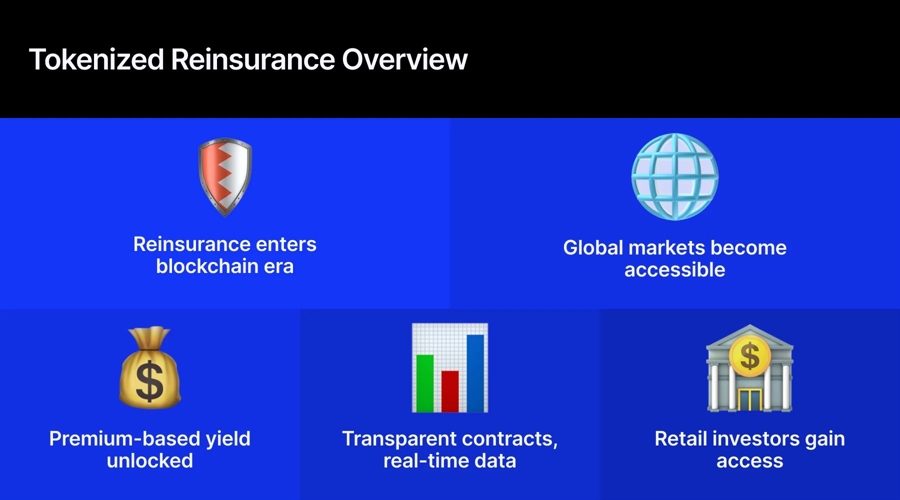
The bridge between traditional reinsurance and decentralized finance is no longer theoretical. In January 2026, Re, a decentralized reinsurance infrastructure platform, authorized $134 million in reinsurance capacity across multiple programs ahead of the renewal season [[src-serp-1]]. This deployment signals a shift from pilot projects to substantial, live capital allocation.
By tokenizing reinsurance capacity, platforms like Re allow global capital to flow directly into DeFi risk pools. This mechanism bypasses the slow, intermediary-heavy processes of traditional Lloyd’s syndicates, enabling faster capital deployment and greater transparency for investors seeking yield through risk assumption.
The scale of this capital is significant. While $134 million may seem modest compared to the multi-trillion-dollar global reinsurance market, it represents a critical mass of on-chain liquidity that can absorb complex smart contract risks. This model proves that tokenized capacity can handle real-world underwriting cycles.
ComparisonTable
| Feature | Traditional Reinsurance | Tokenized On-Chain Capacity |
|---|---|---|
| Capital Deployment | Weeks to months | Minutes to hours |
| Transparency | Private bilateral contracts | Public on-chain ledger |
| Minimum Investment | High institutional thresholds | Fractional, accessible |
| Settlement | Net 30-90 days | Smart contract automated |
This efficiency allows DeFi protocols to secure coverage that was previously too expensive or slow to obtain. As more capital enters these tokenized pools, the cost of insurance for decentralized applications is expected to decrease, further stabilizing the broader ecosystem.
Smart contracts automate claim payouts
On-chain reinsurance removes the lag between a loss event and capital deployment. Instead of waiting for manual audits or traditional settlement cycles, smart contracts execute payouts the moment verified data confirms a risk event. This automation turns reinsurance from a reactive administrative burden into a real-time liquidity buffer.
The core mechanism relies on oracles—external data feeds that bridge off-chain reality with on-chain logic. When a parameter triggers a loss, such as a DeFi protocol experiencing a hack or a stablecoin depegging beyond a set threshold, the oracle records the event. The smart contract then reads this input and automatically releases the reinsured capital to the affected party. There is no need for human intervention to approve the claim, which drastically reduces counterparty risk and settlement delays.
This system requires strict definition of what constitutes a "loss." Parameters are hardcoded into the contract, ensuring that payouts are predictable and transparent. For example, if a protocol's TVL drops by 50% due to a confirmed exploit, the reinsurance layer automatically covers the deficit up to the agreed limit. This immediacy stabilizes the ecosystem, preventing cascading failures that often follow liquidity shocks.
Regulatory clarity drives institutional adoption
By 2026, the regulatory landscape for crypto reinsurance has shifted from experimental gray zones to structured compliance frameworks. This clarity is the primary catalyst for institutional capital inflows, transforming DeFi risk management from a niche crypto-native activity into a standard component of traditional insurance balance sheets.
Regulators in key jurisdictions have established clear guidelines for how digital assets can be held, audited, and transferred within reinsurance contracts. This reduces the legal uncertainty that previously deterred large insurers and pension funds. With defined rules for capital adequacy and risk weighting, institutions can now allocate significant reserves to crypto-backed reinsurance pools without fearing regulatory arbitrage or sudden compliance shifts.
The result is a surge in institutional participation. Traditional reinsurers are integrating AI-driven models to assess and price digital asset risks, leveraging real-time data to ensure solvency. This convergence of regulatory certainty and AI precision allows for larger, more stable capital pools that can absorb significant market volatility.
No comments yet. Be the first to share your thoughts!