
Regulatory shifts in 2026
The crypto reinsurance landscape in 2026 is defined by a decisive pivot from voluntary self-regulation to mandatory compliance frameworks. Regulators in major markets are no longer treating digital assets as peripheral curiosities; they are now central to solvency calculations and capital reserve requirements for traditional insurers.
This shift is driven by the need to standardize how crypto-linked risks are underwritten. Previously, reinsurance treaties involving digital assets operated in a gray area, relying on ad-hoc agreements. In 2026, primary regulators are demanding transparent reporting of crypto exposure, forcing reinsurers to adopt rigorous risk models that account for volatility, custody risks, and smart contract vulnerabilities.
For reinsurers, this means integrating AI-driven risk models that can process real-time market data against regulatory thresholds. The goal is to ensure that capital reserves are adequate not just for traditional perils, but for the unique, high-frequency risks of the crypto ecosystem. This compliance burden is reshaping partnerships, as traditional reinsurers seek specialized crypto-native partners to manage these complex exposures.
The transition is not without friction. Traditional reinsurers must adapt their actuarial models to include crypto-specific variables, while crypto firms must navigate increasingly complex licensing requirements. This regulatory clarity, however, is essential for the sector to scale. It provides the legal certainty needed for large-scale institutional capital to enter the crypto insurance market, moving it from a niche product to a mainstream risk management tool.
AI-driven risk modeling
Artificial intelligence is replacing static actuarial tables with dynamic, real-time risk assessment engines. Traditional reinsurance models rely on historical data that often fails to capture the instantaneous volatility of crypto markets. AI-driven models ingest live on-chain data, smart contract interactions, and market sentiment to adjust risk premiums continuously.
These systems evaluate smart contract risks by analyzing code vulnerabilities and historical exploit patterns. Instead of waiting for an incident to occur, AI models predict potential failure points based on network congestion, liquidity depth, and protocol changes. This proactive approach allows reinsurers to price coverage more accurately for complex DeFi protocols.
The shift to AI also addresses the unique correlation risks in crypto. Unlike traditional assets, crypto markets often move in unison during liquidity crunches. Machine learning algorithms detect these non-linear correlations, providing a more realistic view of tail risks. This precision helps insurers avoid underpricing exposure during market stress.
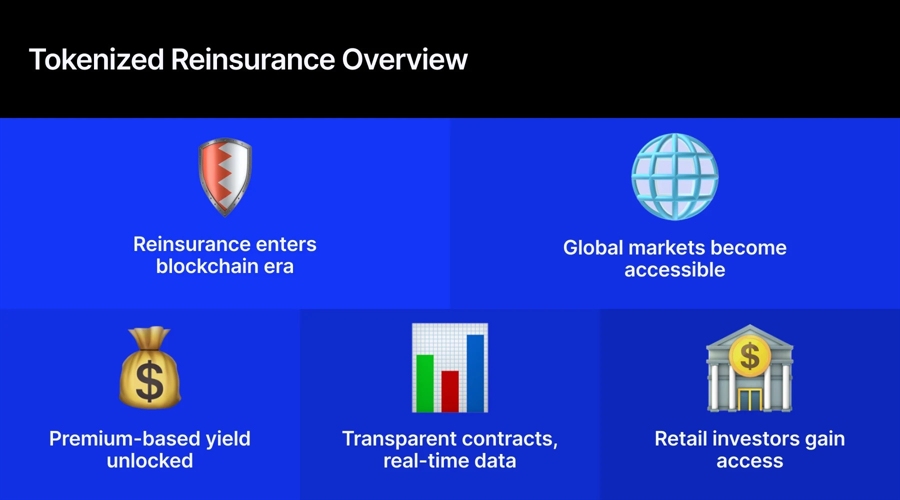
As the industry matures, the integration of AI into reinsurance pricing is becoming standard. Platforms like Re are leveraging this technology to deploy capital more efficiently, ensuring that reserves are sufficient to cover sudden market swings. The result is a more resilient reinsurance market that can withstand the inherent volatility of digital assets.
Onchain capital deployment
Tokenized reinsurance platforms are reshaping how capital moves into 2026 renewals. By placing reinsurance capacity on-chain, platforms like Re have authorized $134 million across multiple programs, significantly reducing the time it takes to deploy funds compared to traditional methods [[src-serp-1]]. This shift allows capital to move instantly, aligning with the broader trend of bringing the $850 billion reinsurance market on-chain through protocols like OnRe [[src-serp-7]].
The primary advantage is efficiency. Traditional reinsurance relies on lengthy settlement cycles and intermediary layers, whereas onchain protocols utilize smart contracts to automate capital calls and claims verification. This reduces friction and lowers the cost of capital for both insurers and retrocessionaires.
The table below compares the deployment mechanics of traditional reinsurance against onchain protocol deployment.
| Feature | Traditional Reinsurance | Onchain Protocol |
|---|---|---|
| Capital Deployment | Days to weeks | Minutes to hours |
| Settlement | Net 30-90 days | Real-time or instant |
| Intermediaries | Multiple brokers and custodians | Smart contract automation |
| Transparency | Limited to direct partners | Publicly verifiable on-chain |
| Capital Efficiency | High idle capital requirements | Dynamic liquidity pools |
These structural changes allow for more responsive capital allocation, particularly during peak renewal periods when speed and certainty are critical.
Compliance and Audit Requirements for Crypto Reinsurance
In 2026, the regulatory framework for crypto reinsurance contracts has shifted from voluntary guidelines to mandatory, auditable compliance protocols. This change is driven by the need to integrate traditional insurance standards with the immutable nature of blockchain technology. Reinsurers are now required to implement real-time monitoring systems that track policy lifecycle events—from inception to payout—ensuring every transaction is verifiable by regulators.
The core of this compliance structure relies on three specific audit trails: smart contract execution logs, capital reserve attestations, and cross-border data privacy checks. Smart contract logs must be immutable and time-stamped, providing a clear record of when coverage triggers were activated. For example, if a DeFi protocol hack occurs, the reinsurance contract’s automatic payout must be traceable back to the exact block number and transaction hash, eliminating ambiguity in claims processing.
Capital reserve attestations are equally critical. Unlike traditional reinsurance, where solvency is checked quarterly, crypto reinsurance requires continuous proof of reserves. This is often achieved through zero-knowledge proofs (ZKPs), which allow reinsurers to prove they hold sufficient assets to cover liabilities without revealing sensitive portfolio details. This balance between transparency and privacy is essential for maintaining trust among regulated insurance carriers.
Cross-border data privacy adds another layer of complexity. Since crypto transactions are global, but insurance regulations are local, reinsurers must ensure that data handling complies with both the jurisdiction of the cedant (the insurance company buying reinsurance) and the location of the reinsurer. Failure to align these data flows can result in significant fines and the revocation of operating licenses. As the industry matures, expect these compliance checks to become automated through AI-driven regulatory tech (RegTech) platforms, reducing manual audit burdens while increasing accuracy.
Crypto reinsurance market outlook
Institutional capital is beginning to bridge the gap between traditional risk transfer and decentralized finance. The $850 billion reinsurance market is seeing early onchain adoption, with protocols like OnRe delivering regulated reinsurance yields of 9–15% on Solana [[src-serp-7]]. This shift signals a move toward integrating real-world insurance liabilities into yield-generating DeFi strategies.
Venture interest remains a key indicator of sector momentum. In June 2026, Coinbase Ventures made a strategic investment in Re, an onchain protocol designed to connect real-world reinsurance capital with digital assets [[src-serp-6]]. Such investments suggest that major crypto exchanges are positioning themselves to underwrite or facilitate these new financial instruments.
However, volatility remains a barrier for traditional insurers. The National Association of Insurance Commissioners notes that cryptocurrencies remain atypical investments for U.S. insurers due to their speculative nature and price swings [[src-serp-7]]. As regulatory frameworks solidify in 2026, the market will likely see a clearer divide between speculative crypto assets and stable, regulated reinsurance products.
No comments yet. Be the first to share your thoughts!