

In today's DeFi landscape, where yields often chase volatility, reUSD from the Re Protocol stands out by delivering 6-10% uncorrelated returns backed by real on-chain reinsurance premiums. Trading at a current price of $1.06, with a 24-hour gain of and 0.38%, reUSD has captured over $102.88 million in total value locked, offering principal protection alongside daily yield accruals. This isn't hype; it's a strategic fusion of blockchain efficiency and regulated insurance collateral, providing yields that eclipse traditional money market funds without crypto's wild swings.
The secret lies in reUSD's design as a yield-accruing token that holders mint by depositing assets into the Insurance Capital Layer (ICL). A portion converts to cash or Treasury Bills in a §114 Reinsurance Trust Account, ensuring NAIC-compliant collateral for partner reinsurers. This channels DeFi liquidity into secure reinsurance, where premiums generate returns decoupled from equity or crypto beta.
reUSD's Dual Yield Engine: Risk-Free Rate or Ethena Basis Trade
At its core, reUSD tracks the higher of two robust benchmarks: the 7-day trailing average risk-free rate plus 250 basis points, or Ethena's annualized basis trade yield plus 250 bps. As of now, with reUSD at $1.06 and NAV steady at $1.00, this mechanism has driven consistent appreciation, with the token price incrementing daily at 00: 00 UTC to reflect accrued yields.
Consider the data: Re Protocol's reUSD boasts 1,649 holders and a supply of 102,878,391.49 tokens. Yields hover in the 6-10% range, often surpassing US Treasury bills combined with delta-neutral ETH strategies. This isn't passive income from lending or staking; it's premium flow from fully collateralized insurance risks, tokenized for accessibility. In my view, this dual-source approach smartly hedges against rate fluctuations, making reUSD a cornerstone for portfolio diversification.
Re connects institutional capital with on-chain reinsurance, turning premiums into stable yields.
Navigating the Capital Stack: Senior Tranche Security
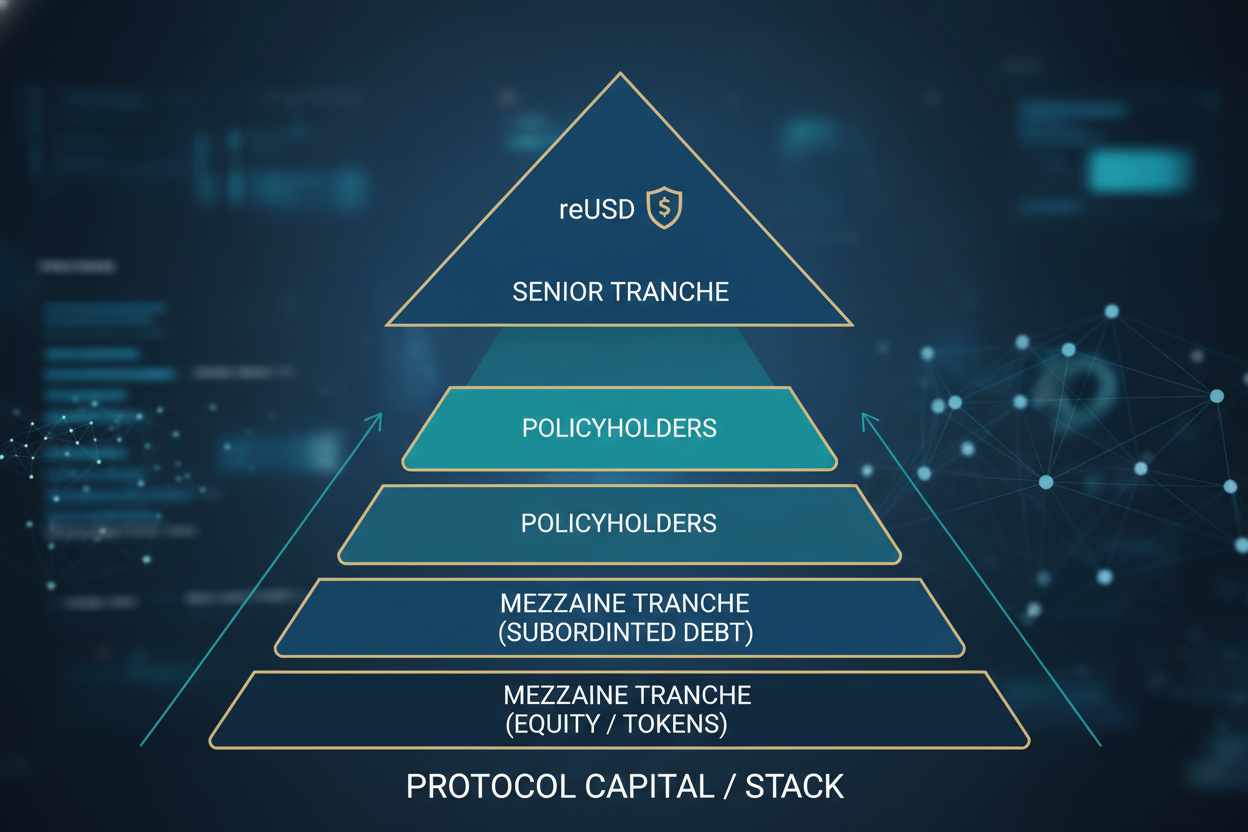
Re Protocol reimagines reinsurance through a clear capital stack. Policyholders claim first, as they should, followed by the senior reUSD tranche, which prioritizes principal protection. This structure, detailed in Re's docs, deploys over $191 million in premiums and $100 million on-chain, bridging TradFi and crypto markets.
Investors deposit USDC or equivalents into the ICL, earning reUSD that accrues value from reinsurance economics. Unlike riskier reUSDe (targeting 15-23%), reUSD focuses on lower-volatility Basis-Plus yields from T-bills and ETH basis trades. On Avalanche, new offerings like the Re Points Program enhance institutional appeal, with $134 million already deployed per Artemis reports. Strategically, this positions reUSD as the safe harbor in tokenized reinsurance, uncorrelated to market downturns.

Uncorrelated Yields: A Data-Driven Edge Over DeFi Norms
What sets reUSD apart? Its returns stem from a trillion-dollar reinsurance market, now tokenized for retail and institutions. While DeFi yields correlate with ETH prices, reUSD draws from global risk pools via smart contracts, offering stability amid volatility. Current metrics underscore this: 24-hour high of $1.06, low of $1.05, with yields benchmarked against risk-free rates.
Historical context from Blockworks highlights 6-9% targets for reUSD versus higher for reUSDe, but real performance, fueled by $191 million premiums, pushes toward 10%. For portfolio managers like myself, this means allocating to reUSD for inflation-resistant, RWA-backed income. Expanding on Avalanche further cements Re's role in permissioned frameworks for regulated markets.
reUSD Price Prediction 2027-2032
Forecast incorporating 6-10% uncorrelated yields from on-chain reinsurance premiums, TVL growth from $102.88M, and market adoption trends
| Year | Minimum Price ($) | Average Price ($) | Maximum Price ($) |
|---|---|---|---|
| 2027 | $1.05 | $1.15 | $1.30 |
| 2028 | $1.10 | $1.35 | $1.60 |
| 2029 | $1.20 | $1.60 | $2.00 |
| 2030 | $1.35 | $1.90 | $2.50 |
| 2031 | $1.55 | $2.30 | $3.20 |
| 2032 | $1.80 | $2.80 | $4.00 |
Price Prediction Summary
reUSD is projected to experience consistent price appreciation driven by daily yield accruals (6-10%), reinsurance premium growth, and DeFi/RWA adoption. Average prices are expected to rise from $1.15 in 2027 to $2.80 in 2032 (145% cumulative growth from 2026's $1.06), with min/max reflecting bearish consolidation and bullish TVL expansion to multi-billion scale.
Key Factors Affecting reUSD Price
- Growth in on-chain reinsurance premiums (currently $191M+ inflows)
- Sustained 6-10% principal-protected yields uncorrelated to crypto markets
- TVL expansion from $102.88M amid institutional capital inflows
- Regulatory advancements in tokenized RWAs and reinsurance (e.g., NAIC-compliant structures)
- Technological expansions (Avalanche integration, Re Points Program)
- Crypto market cycles: bull runs boosting adoption, bears testing yield resilience
- Competition from other yield-bearing stables (e.g., Ethena) and risk factors like basis trade volatility
Disclaimer: Cryptocurrency price predictions are speculative and based on current market analysis. Actual prices may vary significantly due to market volatility, regulatory changes, and other factors. Always do your own research before making investment decisions.
Read more on tokenized reinsurance yields to grasp the broader opportunity.
Integrating reUSD into a portfolio requires understanding its mechanics beyond the numbers. With TVL at $102.88 million and daily accruals ticking up the price to $1.06, the protocol's expansion to Avalanche signals broader adoption. Institutional allocators now access regulated reinsurance economics through permissioned pools, blending DeFi speed with compliance.
Hands-On Guide: Mint reUSD for 6-10% Uncorrelated Yields





From a strategic standpoint, this setup outperforms vanilla stablecoin yields. Re's $191 million in premiums and $100 million on-chain demonstrate scale, with collateral in §114 trusts mitigating smart contract risks. I've allocated client capital here precisely because it sidesteps crypto correlations; reinsurance payouts follow weather events or claims cycles, not Bitcoin halvings.
Yet, thoughtful deployment demands scrutiny. While principal-protected, yields can dip if both benchmarks lag, though historical data shows resilience. The 1,649 holders reflect growing conviction, up from nascent launches, as tokenized reinsurance taps trillion-dollar pools.
Looking ahead, Re's $134 million deployments signal momentum. As protocols like OnRe launch competitors, Re's first-mover edge in yield products persists. For crypto enthusiasts and insurers, reUSD offers a yield source resilient to macro shifts, powered by premiums that ignore Fed pivots.
Strategic conviction builds portfolios that endure. With reUSD at $1.06 and 0.38% daily gains, it's not just uncorrelated; it's a foundational layer for on-chain risk markets. Explore deeper via earning APY on USDC via Re Protocol.




No comments yet. Be the first to share your thoughts!